.jpg)

Danville homeowners need an electrician they can trust — someone who diagnoses the real problem, explains it clearly before starting, charges what was quoted, and leaves the work permitted and inspected when the project calls for it. That is the standard we hold ourselves to on every call. Most of what determines whether electrical work holds up for decades happens behind the wall, where you never see it, so we treat that hidden work with the same care as the parts you can. Rocky Coast Electric provides residential and light commercial electrical services in Danville, Maine — from routine outlet additions and panel inspections to whole-home rewiring, generator hookups, and EV charger installation.
Whether you are facing a specific problem today, planning an upgrade, or simply overdue for a safety check on an older home, this page covers when a licensed electrician is genuinely needed, what warning signs to watch for, and the questions worth asking before you hire anyone to work on your home's electrical system.
Electrical Services Rocky Coast Electric Provides in Danville, ME
Panel Inspections, Upgrades, and Replacements
The electrical panel is the heart of your home's electrical system. An aging panel with an undersized service, outdated breaker technology, or one of the documented problem brands — Federal Pacific Electric Stab-Lok and Zinsco panels in particular — is a safety and reliability concern no matter how well the rest of the wiring has been kept up. We inspect panels honestly, explain what we find in plain terms, and recommend upgrades only when the findings actually support them. When a panel upgrade is needed, we coordinate the full project, including the Central Maine Power service entrance work where required.
Whole-Home and Partial Rewiring
Danville homes built before the mid-1970s may have aluminum branch circuit wiring, knob-and-tube wiring, or original wiring whose insulation has reached the end of its safe life. These conditions are not always visible from the outside — they turn up during inspections, renovations, or when a problem forces walls open. We assess what is there, lay out the options honestly, and do rewiring work that brings your home into safe, code-compliant condition with the right permits and inspections. The goal is always work that lasts, not a patch that looks fine on the invoice and fails later.
Circuit Additions and Outlet Installation
Home office additions, finished basements, new appliances needing dedicated circuits, kitchen remodels that need more receptacles — these are everyday projects that call for a licensed electrician once new wiring has to be run. We add circuits to your panel, route new cable cleanly through walls and ceilings, and install outlets, switches, and fixtures to code and to your specifications. The cable you never see gets the same attention as the cover plate you do.
EV Charger Installation
A Level 2 EV charger at home makes a real difference day to day — charging overnight at 240 volts instead of trickling off a standard outlet. We install dedicated 240-volt circuits and EVSE equipment from major brands, sized for your vehicle's charging needs and your panel's available capacity. For homes where the panel needs to grow before the charger can be added, we handle both as part of the same project rather than leaving you to sort it out later.
Generator Transfer Switches
Maine winters can deliver multi-day outages. A manual transfer switch for a portable generator, or an automatic transfer switch for a whole-home standby unit, lets you run essential loads — heating system, well pump, refrigerator, lighting — safely and without backfeeding the utility lines. We size, install, and permit transfer switches for all generator configurations.
Safety Inspections
A professional inspection is a practical investment for any home that has not had one in ten-plus years, any home being bought or sold, or any older Danville property whose electrical history is unknown. We document what we find clearly: what is safe and working well, what should be watched, and what needs to be addressed. No inflated findings, no manufactured urgency. We would rather you trust us with the next twenty years of your home than oversell you on one visit.
Troubleshooting
Flickering lights on one circuit or across the house. A breaker that trips repeatedly under normal load. Outlets that stopped working. A burning smell from a switch or receptacle. These problems have specific causes that accurate diagnosis identifies — and specific fixes that actually resolve them rather than masking the symptom. We diagnose before we recommend.
When Should You Call a Professional Electrician in Danville, ME?
Most homeowners are unsure where the DIY line is with electrical work. Here is a practical guide for Danville residents.
Call Immediately — These Are Safety Situations
- Electrical emergencies: call Rocky Coast Electric at (207) 576-2541, or 911 if fire is involved.
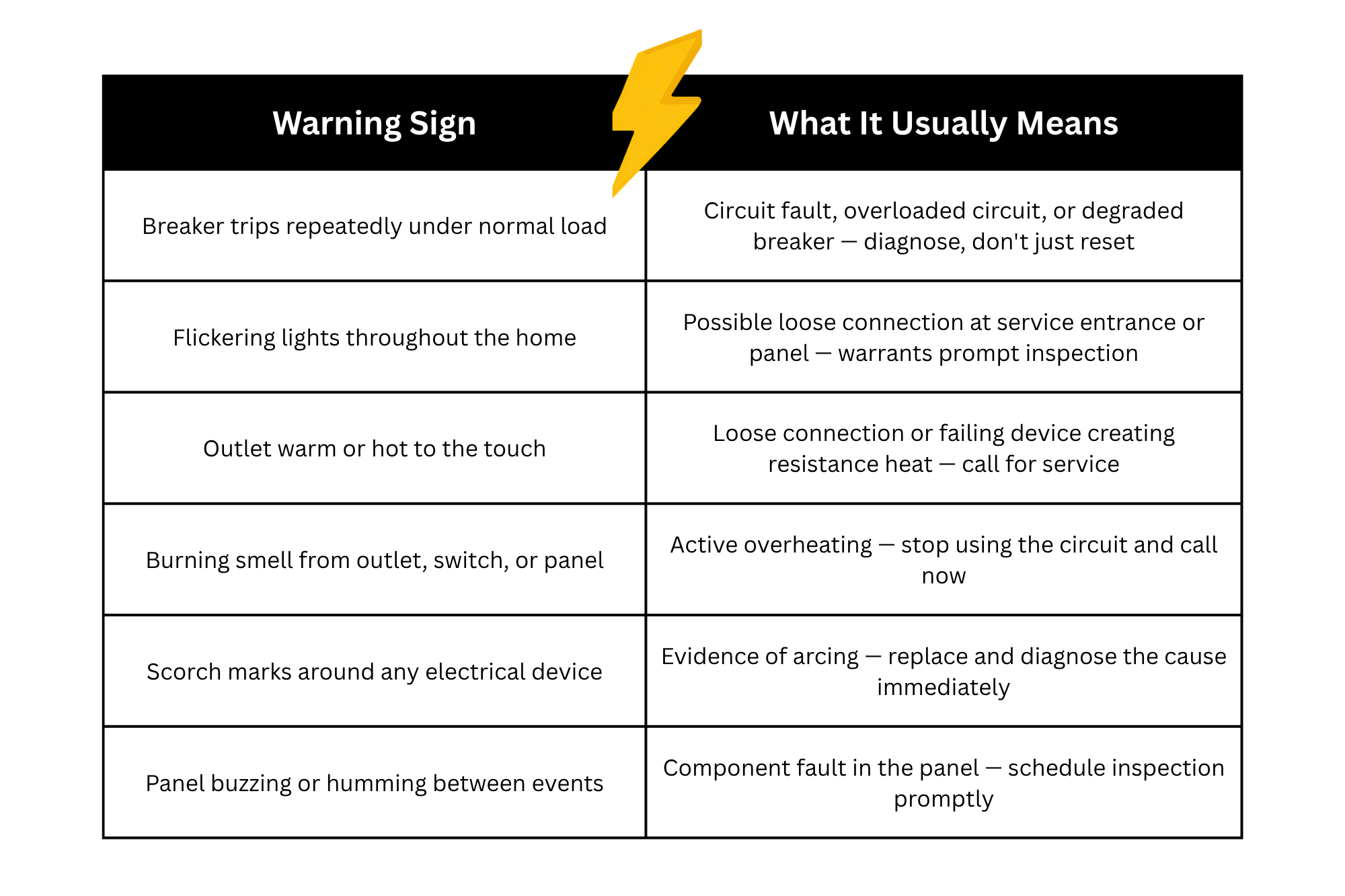
- Burning smell from an outlet, switch, or panel: stop using the circuit and call. Do not wait to see if it goes away.
- Scorch marks or discoloration around outlets, switches, or the panel face: evidence of arcing or overheating that needs immediate attention.
- An outlet or switch that is warm or hot to the touch: normal components should not produce noticeable heat.
- Sparking when plugging in or unplugging a device: a brief spark on disconnect is normal; sustained sparking, or sparking when plugging in, is not.
- A breaker that trips immediately on reset, repeatedly: a fault exists on the circuit. Do not keep resetting — diagnose the cause.
Call Before Starting — These Projects Require a Licensed Electrician
Maine law and the National Electrical Code require licensed electricians for most new installation work, and practical safety requires it for all of it:
- Any work on the main panel — adding breakers, replacing the panel, or upgrading service
- Installing new circuits or running new wire from the panel to new locations
- EV charger installation — a 240-volt dedicated circuit with EVSE equipment
- Generator transfer switch installation — improper wiring can backfeed utility lines and kill lineworkers
- Whole-home or partial rewiring
- Installing or replacing wiring inside walls as part of a renovation
- Any electrical work on rental or investment property — the Maine homeowner exemption does not apply
Call for Diagnosis — Even if the Fix Turns Out to Be Minor
Some problems that look like simple DIY fixes turn out to have a cause further back in the circuit that a homeowner would never find without tracing the wiring. A dead outlet may be downstream of a tripped GFCI that just needs resetting — or it may point to a wiring fault at a junction box inside a wall. A breaker that trips under moderate load may need replacing — or the load it serves may have developed a fault. A diagnosis call confirms the actual cause before any work is done, so you are not paying to replace a symptom while the real problem stays hidden.
Call for Planning — Before Renovations Begin
If you are planning a kitchen remodel, finishing a basement, adding a home office, or doing any renovation that needs new electrical capacity, calling a licensed electrician before the project starts — not partway through with the walls already open — lets the electrical planning happen in step with the overall project instead of as a forced, last-minute scramble. We can assess your panel's available capacity, advise on circuit placement for the layout, and give you accurate cost information before the work begins.
What Are Signs You Need an Electrician in Danville, ME?
Some warning signs are obvious emergencies. Others develop slowly and are easy to write off as minor quirks — until they are not. Here are the ones that warrant a call.
Breakers That Trip Repeatedly
A breaker that trips once under an unusual load is doing its job. A breaker that trips regularly under normal household loads has either developed a fault in the circuit it serves, has a load that now consistently exceeds its rating and needs to be split onto a new circuit, or has itself degraded and trips below its rating. Each scenario has a different fix, and none of them is "just reset the breaker."
Flickering or Dimming Lights
Lights that flicker briefly when a large appliance starts — the fridge compressor, the well pump — are reflecting a voltage sag that is generally normal. Lights that flicker continuously, flicker with no obvious large-load trigger, or dim and brighten in a slow wave are showing a different condition. Continuous flickering on one circuit may mean a loose connection. Flickering throughout the home may mean a loose connection at the service entrance or panel — a more serious finding that warrants immediate attention.
Outlets That Are Dead, Warm, or Discolored
A dead outlet is a diagnostic question: is it downstream of a tripped GFCI somewhere else (common in older wiring, where a bathroom or kitchen GFCI may protect outlets in unexpected places), or is there a wiring fault? A warm outlet is not normal and points to resistance heating from a loose connection or failing device. A discolored or scorch-marked outlet has arced and needs replacing, along with a diagnosis of what caused it.
Burning or Electrical Smells
A brief smell of hot dust when the heat first runs in fall is normal. A persistent burning smell from an outlet, switch, or the panel area is not — it means components are reaching temperatures that degrade insulation and can start a fire. This is a call-now situation, not a monitor-and-see one.
An Electrical Panel That Is Old, Warm, or Makes Sounds
Panels should run silently and stay close to room temperature on the exterior. A panel that buzzes, hums, or clicks between switching events has a component issue that needs inspection. A panel that feels warm to the touch is generating heat inside that should not be there. Both warrant immediate professional evaluation.
A Home That Has Never Had an Electrical Inspection
If you have owned your Danville home more than 10 years without a professional inspection — or recently bought an older home without having the electrical system evaluated — scheduling one is a reasonable, practical investment. Problems in older homes often develop silently over years and only surface when they reach visible failure or when a renovation opens the walls.
What Are Good Questions to Ask an Electrician in Danville, ME?
Hiring an electrician is a real decision, especially for larger projects. These questions reveal whether a contractor is prepared to do the work correctly and honestly.
Are You Licensed in Maine, and Will You Pull the Permit?
Maine requires electrical contractors to be licensed, and most installation work requires a permit from the State Fire Marshal's Office or local authority. An electrician who offers to skip the permit to save time or money is offering work that is not inspected, that can create issues with your homeowner's insurance, and that complicates future sales when it shows up in an inspection report. The right answer is simple: licensed, yes — and permits pulled and inspections coordinated as part of the project.
What Did You Find, and What Does It Actually Require?
After any diagnostic visit, you should get a clear explanation of what the electrician found, what they believe caused it, and exactly what work is needed to address it. A contractor who describes findings vaguely and jumps straight to pricing is not giving you what you need to weigh the recommendation. Ask plainly: what is the problem, what is causing it, and what exactly are you proposing to fix it?
What Is Included in the Price, and What Would Change It?
Electrical work can run into surprises — walls that need opening more than expected, wiring that needs more remediation than was visible, or panel capacity that turns out short for the proposed additions. A good electrician gives you a clear itemized estimate and explains what conditions would change the scope. Not every project can be quoted to the dollar before starting, but you should understand what you are agreeing to pay for and what would change it.
How Long Have You Worked in This Area, and Do You Know Maine's Local Code Amendments?
Maine adopts the National Electrical Code with state-specific amendments, and the State Fire Marshal's Office has inspection requirements that differ from the base NEC. An electrician with Maine experience knows these and works to them routinely. An out-of-state contractor, or one unfamiliar with Maine, may install work that would pass elsewhere but fails a Maine inspection — leaving you with failed-inspection costs and correction work. We make a point of staying current with these requirements, because in this trade there is always something new to keep up with.
Will You Document What You Find and What You Did?
A written record of an inspection's findings and a clear invoice describing the work are both documents that serve you well over time. Findings document the system's condition at a point in time, which helps with tracking changes and future decisions. A detailed invoice helps with insurance and gives history to future buyers or electricians. Ask whether written documentation comes with the service.
What Is Your Timeline, and Will You Be the One Doing the Work?
Some contractors take on more than their own crew can complete and subcontract parts of a project to workers they do not directly supervise. Ask plainly whether the person you are talking to will do the work, or whether subcontractors will be involved. At Rocky Coast Electric, we do not subcontract — the work we quote is the work we perform, and we are only willing to put our name on a result we did ourselves.
Electrical Work in Danville, ME: What We See in Local Homes
Danville is a small rural community in Androscoggin County with a mix of older farmhouses, mid-century homes, and newer construction. The electrical characteristics we run into most often here:
Older main panels with limited capacity. Homes built before the 1980s often have 100-amp or smaller services that suited the appliance loads of the era but get strained by modern demand. EV charging, electric heat backup, large HVAC, and multiple home offices push these panels past comfortable capacity.
Knob-and-tube wiring in pre-1950s construction. Some older Danville farmhouses still have original knob-and-tube wiring in parts of the home. It is not inherently dangerous when intact, but it is not compatible with modern ground-fault and arc-fault protection, it should never be buried in insulation, and it has a finite remaining life. We assess it honestly rather than reflexively pushing a full rewire.
Generator readiness. Rural Maine residents understand outage risk better than most. Many Danville homeowners are either running portable generators without a transfer switch — which creates utility backfeed risk — or are ready to formalize their backup power. A transfer switch is one of the most practical investments for a rural property here, and a real step toward depending less on the grid when the grid goes down.
Well pump and heating system circuits. Rural homes with drilled wells depend on an electrically operated pump. That circuit's condition — wiring, breaker sizing, grounding — is one of the most important in the home to keep reliable. We include well pump circuit inspection in any comprehensive electrical assessment in Danville.
Building Toward a More Self-Sufficient Home
A lot of what we do in Danville comes back to the same idea: a home that depends less on outside systems and holds up when conditions get hard. Generators and transfer switches, EV chargers, heat pumps, battery storage, and solar are all part of that picture, and all of it runs through your panel — which means most of it depends on having the capacity and the wiring to support it.
That is where getting the foundation right pays off quietly for years. Size the service correctly the first time and run the right wire for what you are planning, and you are not paying to redo it when you add the next piece. We would rather help you plan a system that grows with your home than sell you the smallest thing that works today. Helping Maine families build homes that are safer, more efficient, and more independent is the part of this work we care about most.
Why Danville Homeowners Choose Rocky Coast Electric
- Licensed in Maine — permits pulled and inspections coordinated for every project that requires them
- Honest assessments — we explain what we find before recommending any work
- Clear written estimates — you know what you are agreeing to before any work begins
- We do not subcontract — the electrician you hire is the one who does the work
- Experience with Maine homes of all eras — knob-and-tube, aluminum wiring, older panels, modern construction
- Practical rural Maine perspective — generator hookups, well pump circuits, and outage preparedness are not afterthoughts for us
We are not the cheapest electrician around, and we are not trying to be. We use better materials, take the time to do it properly, and stand behind the result. If lowest price is the only thing that matters, we are probably not your company — and that is fine. But if you care about your home and want work that lasts, that is exactly who we are built for.
Call (207) 576-2541 or visit www.rockycoastelectric.com to schedule service or request an estimate.
Frequently Asked Questions
We serve Danville and the surrounding Androscoggin County communities from our base in the Lake Auburn area. Call (207) 576-2541 to confirm availability for your specific location.
Yes. We assess knob-and-tube honestly — documenting its condition, flagging any spots where it has been buried in insulation (a fire hazard that needs correction), and advising on a realistic remediation plan based on your home and your priorities. We do not reflexively recommend a full rewire when targeted remediation is the better answer.
A residential inspection covers your main service panel, visible accessible wiring, GFCI and AFCI protection in required locations, outlet and switch condition throughout the home, and any specific concerns you raise. Most take two to three hours depending on home size and what we find. We provide written findings that clearly separate immediate safety concerns from items to monitor over time.
Yes. A manual transfer switch for a portable generator is one of the most practical improvements for a rural Maine home. We size it for the circuits you want to power during an outage — typically heating system, well pump, refrigerator, and lighting — install it to code with proper labeling, and test full operation before completing the project.
Yes. Rocky Coast Electric is fully licensed in Maine and carries liability insurance and workers' compensation coverage. We pull permits for all work that requires them and work to the current Maine Electrical Code on every project.
Schedule Your Electrical Service in Danville, ME
Whether you need a safety inspection on an older property, help with a specific problem, a panel upgrade to support modern household demands, or a generator transfer switch before the next winter outage season — Rocky Coast Electric provides the licensed, straightforward service Danville homeowners deserve.
We show up when we say we will, explain what we find before we start, and charge what we quote.
Call us or visit our contact page to request a free estimate today.