.jpg)

Electrical problems have a way of surfacing at the worst possible time — and in Downtown Auburn, where the building stock runs from nineteenth-century Victorian homes to mid-century commercial blocks to newer construction, the range of what can go wrong is considerable. A flickering light, a panel that hums, a breaker that will not stay reset: none of them tells you on its own whether it is a minor nuisance or a safety issue that has been quietly developing behind the wall for years. Most of what determines that answer is in places you never see, which is exactly why it pays to have someone look who knows what they are looking at.
Rocky Coast Electric works throughout Downtown Auburn with both homeowners and commercial property owners. We are not a residential-only shop treating commercial calls as a sideline, and we are not a large commercial outfit that pushes smaller residential jobs to the bottom of the list. We are licensed in Maine for both, and we staff every project — large or small, residential or commercial — with the same licensed crew and the same process, because the work deserves the same care either way.
This article answers the three questions we hear most from Downtown Auburn customers: whether you can upgrade a panel without rewiring the whole house, how to know when a panel actually needs replacing, and what the common signs of an outdated electrical system really look like. If you are weighing a project, or trying to make sense of something you have been living with, this is an honest place to start.
Electrical Repair & Installation Services in Downtown Auburn, ME
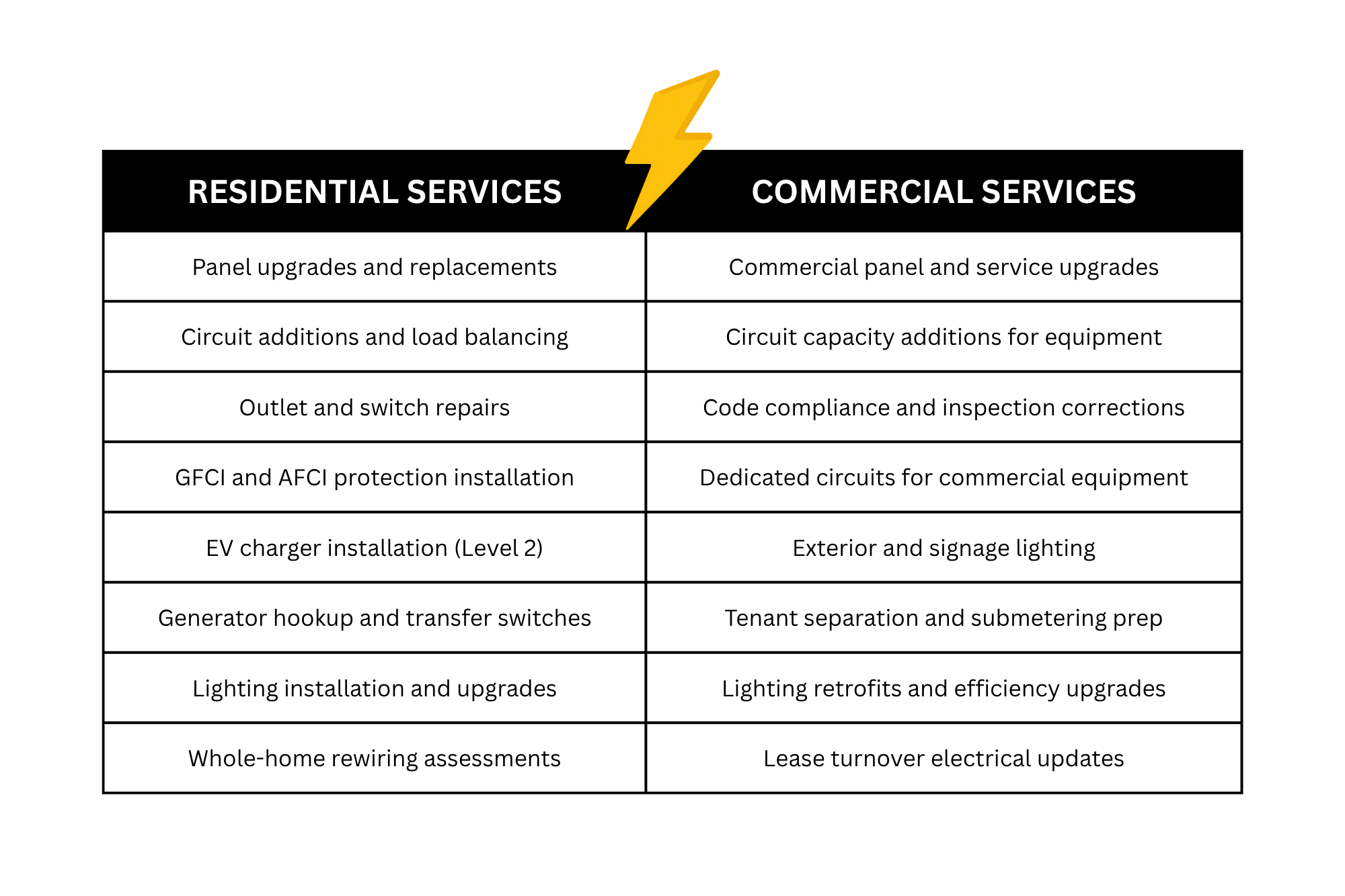
Downtown Auburn properties span a wide range of ages, uses, and electrical conditions. Here is what we handle for residential and commercial customers across the neighborhood.
Every project is handled by Rocky Coast Electric employees from start to finish. No subcontractors, and no hand-off after the estimate. The technician who walks your property and writes the estimate is on the same team as the crew that does the work — so nothing gets lost between the promise and the install.
Can You Upgrade Your Electrical Panel Without Rewiring the House?
Yes — and this is one of the most important distinctions for Downtown Auburn property owners to understand, because the fear of rewiring is often what causes people to put off a panel project that would otherwise be straightforward.
Your electrical panel is the property's distribution hub. It takes power from the utility service and routes it through individual breakers to circuits throughout the building. Upgrading the panel means replacing that distribution equipment — usually to add capacity, fix a reliability problem, or bring the system up to current code for protective devices. The branch circuit wiring that runs through your walls to outlets, fixtures, and appliances is a separate system, and it stays in place unless it has problems of its own.
For a Downtown Auburn homeowner with an original 100-amp panel from the 1970s, upgrading to a modern 200-amp service clears the capacity limits, makes room for new loads like an EV charger or heat pump, and brings the equipment up to a standard that supports today's required protections — without opening a single wall. The same principle applies to a commercial owner adding circuit capacity for new equipment or changing tenant needs.
When Wiring Work May Accompany a Panel Project
Sometimes a panel assessment turns up wiring issues that have to be corrected as part of a permitted project. These are targeted fixes, not a full rewire:
- Circuits where the wire gauge does not match the breaker rating, which has to be corrected before the new panel can be commissioned
- Missing GFCI or AFCI protection that current code requires on a permitted job
- Existing code violations — open junction boxes, improper splices — found during the assessment
- Aluminum branch circuit wiring that needs compatible devices and connectors to be safe and code-compliant
A good electrician will lay out exactly what the panel work involves and what, if anything, needs attention in the branch circuits — and will not pad the scope to make the job bigger than it has to be. We would rather right-size the project honestly than sell you more than your building needs. In most Downtown Auburn homes and commercial buildings, the scope ends up more contained than people expect going in.
How Do You Know If Your Electrical Panel Needs to Be Replaced?
The line for panel replacement is not always a dramatic failure. Plenty of panels that are still technically working are no longer adequate — either because the property's loads have outgrown what the panel was built to serve, or because the equipment itself has reached the end of its reliable life.
The panel is original to a building constructed before 1990. Most panels are designed for 25 to 40 years of service. A panel original to a Downtown Auburn property from the 1980s or earlier is at or past that range, and benefits from a professional assessment even without obvious trouble — especially if no one has looked at it since the building changed hands.
The panel is undersized for current loads. A 100-amp service was standard in mid-century construction and fine for the appliances of that era. It often is not enough for a modern household running air conditioning, a home office, a washer and dryer, a second refrigerator, and an EV charger. Commercial properties hit the same wall as equipment and tenant needs grow. Chronic breaker trips under normal operation are one of the clearest signs a panel is underpowered.
The panel uses a brand with documented reliability issues. Certain panel brands made during certain periods have well-documented histories of breaker failure, connection problems, or fire risk. This is separate from age — it is about whether the specific equipment in your building belongs to a category that warrants replacement. A licensed electrician can identify it during an assessment.
The panel cannot accommodate current code-required protections. Older panels may not accept the AFCI breakers required on bedroom circuits. If your panel cannot be fitted with the protective devices a permitted project requires, replacement is the right path whether or not the panel would otherwise keep running.
What Are Common Signs of an Outdated Electrical Panel?
Whether you own a home, manage a rental, or run a business in Downtown Auburn, these are the indicators that your panel deserves a professional look.
1. The panel is a fuse box rather than a breaker panel. Fuse-based panels predate modern code and cannot support today's required protections. They are not resettable after a fault and cannot accept the AFCI and GFCI devices current standards call for. Any fuse box in a Downtown Auburn property is a replacement priority — and a flag many insurance carriers take seriously.
2. Breakers that trip repeatedly under loads that have not changed. A breaker that trips now and then is doing its job. A breaker that trips regularly under normal use is failing, undersized for the circuit, or telling you the whole panel is running at or above capacity. That pattern points to a panel evaluation, not just a breaker swap.
3. The panel or cabinet feels warm or makes audible sounds. A healthy panel is silent and close to room temperature. Warmth, buzzing, humming, crackling, or popping from the cabinet means heat buildup or arcing inside, and it needs prompt attention. This is not something to keep an eye on over time.
4. Double-tapped breakers. Two conductors sharing a single breaker terminal not rated for two wires is both a code violation and a sign that circuits were added over the years without addressing the panel's real capacity. It is a common finding in older Downtown Auburn properties that have passed through several owners and collected modifications along the way — and a good reminder that cheap work tends to be cheap for a reason.
5. Lights that dim noticeably when appliances or equipment run. Visible dimming across a space when large loads start up means the panel cannot supply peak demand without sagging. That is a performance problem and a sign of chronic stress that only gets worse as loads grow.
6. Visible corrosion, discoloration, or burn marks inside the panel. Heat damage, rust on internal components, melted insulation, or discolored breakers inside the cabinet point to problems that were never addressed. A panel showing these signs should be assessed before a more serious failure occurs.
7. The panel is 30 or more years old and has never been professionally assessed. Even a panel that has run without obvious failure for decades earns a look at this stage. Materials degrade, connections loosen through years of thermal cycling, and the loads on original equipment often exceed what it was built for. For owners buying, selling, or renovating in Downtown Auburn, a panel assessment is simply good due diligence.
Building Toward a More Self-Sufficient Property
A growing share of the panel work we do in Downtown Auburn is really about getting a property ready for what comes next. EV chargers, heat pumps, generators, battery storage, and solar are no longer unusual requests — they are how families and businesses here are lowering their bills and leaning less on outside systems. All of it runs through your service, and most of it depends on having the capacity and the wiring to support it.
That is where doing the foundation right pays off quietly for years. Size a panel correctly the first time and run the right wire for what you are planning, and you are not paying to redo it when you add the next piece. We would rather help you plan a system that grows with your property than install the smallest thing that works today. Helping Maine families and local businesses build toward safer, more efficient, more independent buildings is the part of this work we care about most.
Why Downtown Auburn Customers Choose Rocky Coast Electric
The feedback we hear most from new customers is that they had a hard time finding an electrician who was equally at home on the residential and commercial side, and who gave them a clear, honest read on what their situation actually needed — rather than defaulting to a scope that was bigger or smaller than the job called for.
We are licensed in Maine for both residential and commercial work, and our technicians know the building types in Downtown Auburn: older homes with original or near-original wiring, commercial buildings carrying layered generations of modifications, and rental properties whose electrical history previous owners did not always document well. That familiarity comes from staying curious and treating every building as something to learn from — which is how we work and how we train the people who work with us. There is always something new to learn in this trade, and we would rather keep learning it than pretend we already know everything behind the wall.
Every project starts with a thorough assessment and a written estimate. Work does not begin until the scope and the cost are agreed on, and we handle the permit on every job that requires one. No surprises waiting on the final invoice.
And to be straight with you: we are not the cheapest option in town, and we are not trying to be. We use better materials, take the time to do it properly, and stand behind it. If the lowest price is the only thing that matters, we are probably not your company — and that is fine. But if you care about your property and want work that lasts, that is exactly who we are built for.
Residential and Commercial — Handled the Same Way
We do not treat residential and commercial jobs differently when it comes to care or thoroughness. Whether you are replacing a panel in a Downtown Auburn home or upgrading service for a commercial tenant, the process is the same: assess accurately, estimate transparently, permit correctly, and finish completely.
No Subcontractors on Any Job
Every Downtown Auburn project is staffed by Rocky Coast Electric employees. We do not broker work out to secondary crews after estimating. The person who assesses your project is on the same team as the technicians who complete it — and that is the only way we are willing to put our name on the result.
Frequently Asked Questions
Yes, in most cases. A panel upgrade replaces the distribution equipment and is separate from the branch circuit wiring in your walls. Some wiring corrections may surface during the assessment — mismatched wire gauges, missing code-required protections, or existing violations that have to be addressed on a permitted job — but these are targeted fixes, not a full rewire.
Key signs include a panel over 30 years old that has not been recently assessed, a fuse box rather than a breaker panel, a panel undersized for current loads, a brand with documented reliability issues, visible heat damage or corrosion inside the cabinet, and breakers that trip regularly under normal use. A professional assessment gives you a clear answer based on the actual condition of your equipment.
The most common ones in Downtown Auburn homes and commercial buildings include fuse boxes, double-tapped breakers, panels original to buildings built before 1990, frequent breaker trips, lights that dim when equipment starts, warmth or noise from the panel cabinet, and visible corrosion or heat damage inside. Any of these warrants a professional evaluation.
Yes. We are licensed in Maine for both and serve homeowners, landlords managing rental properties, and business owners throughout Downtown Auburn.
Yes. Panel replacements and service upgrades require a permit under Maine electrical code. We handle the permit application as part of every panel project. Unpermitted panel work can affect your property insurance and create complications during sales or lease transactions, so permitting is a standard part of how we work.
Need Electrical Repair or Installation in Downtown Auburn, ME?
Rocky Coast Electric serves homeowners, landlords, and business owners throughout Downtown Auburn. Licensed, insured, no subcontractors — and committed to doing it right the first time. Call us or visit our contact page to request a free estimate today.